
When finance meets climate action
The Climate Finance Innovation Lab (CFIL) aims to serve as a collaborative platform to ideate, develop, and accelerate innovative climate finance solutions and mechanisms that can mobilise private and public finance to support Malaysia’s transition to net zero, to strengthen its climate resilience and to advance nature-positive actions.

A flagship initiative of the Joint Committee on Climate Change

Strategic partners and collaborators


Climate Finance Innovation Lab (CFIL)
CFIL aims to bridge gaps between policy, capital, and innovation by adopting a whole-of-ecosystem approach, connecting climate projects with policy makers, experts and funders to accelerate climate solutions.
How it works?
Sourcing
An open call will be announced, seeking eligible climate projects to submit applications.
Selection
Projects will be screened based on CFIL Selection & Prioritisation framework.
Financial call
Open call for funders to express interests in the selected projects.
Development
Selected projects undergo structured process involving in-depth analysis and expert guidance from industry professionals and capital providers.
Implementation
The concepts are put into action and fundraising efforts are initiated, with ongoing support from the Lab network.

CFIL Projects
All projects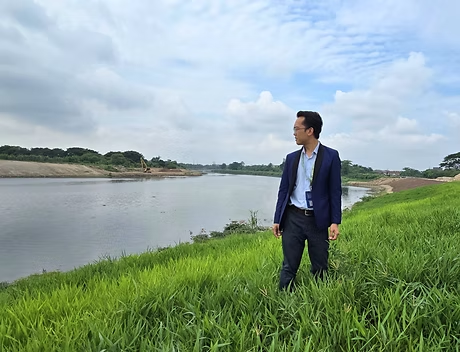
Planters International Berhad
Eco-Restoration and Biodiversity Innovation Program
Thematic area:
Circular economy and sustainable cities
Funding required:
RM2,570,000,000
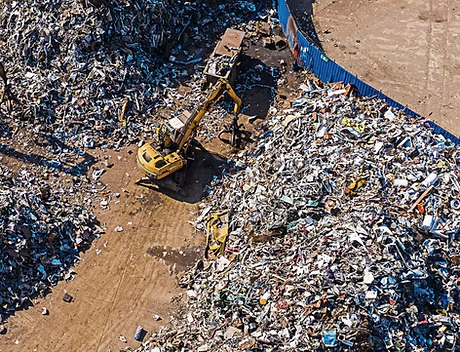
Kota Kinabalu City Hall
Hybrid Waste-to-Energy Complex
Thematic area:
Energy transition and green innovation
Funding required:
RM500,000,000
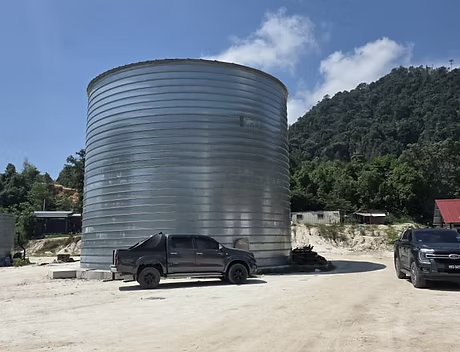
Puvanameta Sdn Bhd
Material Recovery Facility
Thematic area:
Circular economy and sustainable cities
Funding required:
RM2,000,000
Drive national-scale climate impact through the
Climate Finance Innovation Lab
Apply now!
What projects are eligible?
General criteria
- Project shall benefit Malaysia; and
- Project shall contribute to climate mitigation, climate adaptation or nature positive objectives in Malaysia; and
- Project shall be aligned with the national climate agenda and climate goals, such as the National Energy Transition Roadmap (NETR); and
- Project shall comprise one or more activities from the CFIL thematic area.
CFIL thematic area
Energy transition and green innovation
Examples of projects may include, but not limited to:
- Renewable energy
(e.g., solar, hydro, wind, wave, waste-to-energy, small modular reactor) - Energy efficiency
(e.g., waste heat recovery systems, energy efficient products) - Energy distribution and management
(e.g., grid enhancement) - Energy and battery storage
- Green hydrogen
(exclude grey hydrogen) - Bioenergy
(exclude biomass derived from unsustainable logging practices) - Carbon capture, utilisation and storage
(technology-based and nature-based CCUS) - Any other projects identified in the NETR
** Exclude fossil-fuel and coal power generation
Circular economy and sustainable cities
Examples of projects may include, but not limited to:
- Climate adaptation infrastructure
(e.g., flood mitigation system, drainage and stormwater infrastructure) - Green building
(e.g., GBI/LEED/GreenRE certified – silver equivalent and above) - Low carbon transport and infrastructure
(e.g., mass transit, EV charging infrastructure, green fuel bunkering for ports) - Water, sanitation, and hygiene systems
(e.g., water distribution, water treatment plant) - Waste management
(exclude open landfill) - Circular economy
** Exclude fossil fuel-based transport
Sustainable agriculture
Examples of projects may include, but not limited to:
- Food security
(e.g., water irrigation, soil management, sustainable livestock management) - Low-emission agriculture
(e.g., Good Agricultural Practice-certified farming, zero-waste farming, smart farming, precision agriculture)
** Exclude chemical fertilizers and pesticides production, deforestation of high conservation value area
Biodiversity and nature-based solutions
Examples of projects may include, but not limited to:
- Forestry
- Conservation and protection
- Restoration